 We now have our own notice board to put up important announcements of upcoming activities. We will also use this notice board to display the print version of the upcoming newsletter until we can find the resources to mass-reproduce the newsletter for wider distribution. There is an idea floating around about letting people use a portion of the notice board as advertising space so that some funds can be generated to help sustain the activities of Janabahaa Society. After all, it is only with contribution of the community that the Society can sustain its ambitious programs and activities. Any takers? Please get in touch with Tirtha Dhar Tuladhar (phone: 98510-85316) or email info@janabahaa.org.np if you would like to help. Photo by Alok Tuladhar.
Tuesday, July 15, 2008
Notice board, good old style
We now have our own notice board to put up important announcements of upcoming activities. We will also use this notice board to display the print version of the upcoming newsletter until we can find the resources to mass-reproduce the newsletter for wider distribution. There is an idea floating around about letting people use a portion of the notice board as advertising space so that some funds can be generated to help sustain the activities of Janabahaa Society. After all, it is only with contribution of the community that the Society can sustain its ambitious programs and activities. Any takers? Please get in touch with Tirtha Dhar Tuladhar (phone: 98510-85316) or email info@janabahaa.org.np if you would like to help. Photo by Alok Tuladhar.


Saturday, July 12, 2008
Free health camp started


Altogether 15 patients received full check-up from Dr. Matina Tuladhar today during the first free health camp organized by Janabahaa Society at its office. There were about a dozen more who wanted a quick blood pressure checkup. These numbers were much higher than what we had expected, given the fact that we had put up a notice board announcing the camp only at 8 am this morning! We have kept detailed record of all patient data so that it can possibly contribute towards a general health demographics of the local populace in the future. A special feature of this camp was that the Body Mass Index of each patient (BMI) was determined, which is a measure of body fat based on height and weight. After measuring the weight and height, the patient was immediately told in which category she/he fell in – normal, overweight or obese. According to Dr. Tuladhar, the most common problem observed is of high blood pressure. It was originally planned to wrap up the camp within an hour, but due to the constant flow of patients, we could close the camp for the day only at noon. Dr. Tuladhar found this high turnout of patients very encouraging, and has lovingly (hee hee... could not resist the temptation) expressed her willingness to continue volunteering her time and expertise every Saturday for this activity, despite the limited physical resources available. Photos by Alok Tuladhar.
It was all worth it, wasn’t it?


Well, why did so many people put in so much time and effort on all those trips to Jamacho hill? The outcome is going to be something very tangible indeed – the timber that was thus collected has already been cut to size, then seasoned by immersing it – for months – in a special type of oil imported from Birgunj (which was necessary to harden the wood even more), and will finally form the weight-bearing horizontal beams on the main temple of Janabahaa Dyo. The existing beams that are rapidly disintegrating because of age will be replaced with this new wood. Here is a 3D rendering of the temple’s ground floor ceiling structure (top, side and corner views respectively) created by Juju Ratna Tuladhar of Nepal Printing Press, Teuda, Asan.
Lumberjack!
In one of the recent tea-chats at the Janabahaa Society office, no one seemed to know exactly how many wood-cutting expeditions were undertaken to Jamacho hill. Well, digital photography came up with the answer – there were a total of 7 trips – on May 31, June 14, June 20, June 24, August 9, August 10 and August 11 in 2007. I have pictures that were taken on those dates, and I think it is quite unlikely that no one managed to take pictures on any of the trips.
 From what I hear, each and every single trip was a big adventure for the participants. Once you overcame the challenges posed by the soggy weather and the long drive up the winding, climbing path, you were faced with the prospect of climbing up to 100 feet up moss-ridden trees to secure the treetop with ropes…
 or crawl down 100 feet through thick bush to fallen trees to harness them with ropes.
 And then the chain saw would start its deafening grind, scaring off all wild animals in the vicinity that were not yet alarmed by the sudden onslaught of noisy humans in their tranquil surroundings.
 Once the tree is felled, pulling it up to the road was another herculean task – thanks to the manual pulley that acted up on its own mood swings from time to time.
 The best part of course was the food. No one seemed to mind that the hot dishes served had no salt, as all the salt was used as leech-repellent.
 Hauling the logs up onto the trucks was by far the easiest task, as human hands were needed only to guide the lumber into place.
 From what I hear, each and every single trip was a big adventure for the participants. Once you overcame the challenges posed by the soggy weather and the long drive up the winding, climbing path, you were faced with the prospect of climbing up to 100 feet up moss-ridden trees to secure the treetop with ropes…
 or crawl down 100 feet through thick bush to fallen trees to harness them with ropes.
 And then the chain saw would start its deafening grind, scaring off all wild animals in the vicinity that were not yet alarmed by the sudden onslaught of noisy humans in their tranquil surroundings.
 Once the tree is felled, pulling it up to the road was another herculean task – thanks to the manual pulley that acted up on its own mood swings from time to time.
 The best part of course was the food. No one seemed to mind that the hot dishes served had no salt, as all the salt was used as leech-repellent.
 Hauling the logs up onto the trucks was by far the easiest task, as human hands were needed only to guide the lumber into place.
But then keeping the trucks on the road was a different story altogether.
 Tirtha Dhar Tuladhar was probably the only person who went on all the trips.
For the scores of youths from around Janabahaa and others who went on these trips to Jamacho hill (or Raniban or Nagarjun) on the northwestern rim of Kathmandu valley to collect wood required for renovation of Janabahaa Dyo temple, it would prove to be a time they would cherish for a lifetime. For the more inspired, tales that they would tell their grandchildren one day would come out of this experience.
Friday, July 11, 2008
Sizing up the trunk last year
 It has been more than a year – on May 15, 2007 to be precise – that we first went to the dense forest in Jamacho hill (or Raniban or Nagarjun) on the northwestern rim of Kathmandu valley to sur the wood required for renovation of Janabahaa Dyo temple. We first went to the Narayanhivey the trees which we could cut forti palace, picked up a couple of officials from the gate, and went straight to Jamacho. Our task was to measure out the fallen Gwey Chha Sin (or Chilaune) that were pointed out to us by the officials so that we would have a rough estimate for the number of trees that needed to be cut in order to meet the requirement of the renovations.
 I personally went down a 50-meter ravine and measured this fallen tree to the right, which was much more difficult than it looks. I had a hard time balancing myself on the slippery moss-covered tree trunk, and when I finally got to the far end of the tree, I was barely able to get the measuring tape all around it. Hey, how come no one took a picture of me struggling with the task I had taken on myself?
 Tirtha Dhar Tuladhar (far right), Padma Dhar Tuladhar (far left) and the two officials with the reliable Pajero that took us up winding road on the hill.
 Looking north (or is it west? east?) from Jamacho on the way up to the top.
 Can anyone spot Janabahaa in this bird’s eye view of Kathmandu as seen from the top of Jamacho hill?
I have only myself to blame for not posting these pictures earlier. Better late than never! Coming up next: action packed pictures of the gang from Janabahaa felling the trees and hauling them up a truck… manually.
Sunday, July 06, 2008
The Minister
 You see him around all the time, wearing an overcoat during winter and a woolen coat in summer, always by himself. He has youthful features, and carries an air of self dignity. His big, plastic-rimmed glasses and goatee give him the looks of an academician, perhaps even that of the bourgeoisie. His is Mantri (minister), and makes a livelihood by doing odd jobs for anyone who beckons him, including that of a cleaner, helper and porter. Says Mantri, “I go and sleep near Soaltee Hotel when I am in the mood, but when I am too lazy to walk it out, I just got to a nearby restaurant, eat dal, bhat, tarkari and masu, and sleep like a log right here in Janabahaa.” As an afterthought, he adds, “If I inform my friend, he will come and pick me up in his car late at night.” Photo by Alok Tuladhar.
Tuesday, July 01, 2008
Membership update

· We now have a total of 103 members of Janabahaa Society, including the 9 that joined during the First Annual Meet of Janabahaa Society held on Saturday, June 28, 2008. A hearty welcome to the following new members: Manoj Manadhar (Bishalnagar), Laxman Sherstha (Dhumbarahi), Sidhartha Kumar Manadhar (Thamel), Ganga Raj Shakya (Kel Tole), Bikash Bhakta Sherstha (Indra Chok), Dipak Tuladhar (Durbar Marg), Amrit Man Tuladhar (New Road), Subarna Kesari Citrakar (Seto Durbar) and Puspa Ratna Tamrakar (Nyeta Kayganani). Anyone who is interested can become a member of the Society by paying a one-time fee of Rs. 100. Please send an email to info@janabahaa.org.np if you are interested to sign up as a member and we will have someone collect the membership fee from you, or you can just drop in at the Society office from 2 pm to 5 pm on weekdays.
Thursday, June 19, 2008
Janabahaa under seige?

 Browsing through my photo collection, which I do often, I suddenly found myself gawking at these, which instantly triggered off disturbing memories from the not so distant past. What is the deal here? Security forces sealing off Janabahaa? Well, that is what it looks like in these pictures (first one showing the western entrance, and the second one the eastern). If you would like to educate us on what is going on here, please leave your comment below. Hope we will not have to see sights like this ever again. Photos by Alok Tuladhar.
Tuesday, June 17, 2008
Right or wrong?


Many times it is plain outright difficult to ascertain what is right and what is wrong. Like this anonymous letter to the editor says, it is unbecoming to put up the Nepal Football Club Association banner over the main gate of a place as holy as Janabahaa. But then, there are two sides of a coin. What is the other side of the story? Let’s hear it, right here on this blog. Leave your comments, in favor of, and against putting up the banner.
Saturday, May 24, 2008
Mini Library

 Can you believe it? Our very own micro mini library at the Janabahaa Society office has a collection of just over one hundred books already! Some of them were donated by various individuals, while othe
 rs were purchased by Sampurna Tuladhar for use at the library. The books are currently being cataloged as per the ISBN system, and an electronic database of the books will available soon. The books are available for anyone to use during office hours, i.e. 2 pm to 5 pm during week days, but cannot be checked out.
Sunday, May 04, 2008
So, what goes on at Janabahaa?
 This is a blog after all, so it is completely acceptable to put up whatever one knows, as long as it is relevant, even though the information is incomplete. Here is a list of events that take place around, or are related to, Janabahaa.
Friday, August 03, 2007
Final logo... finally
 Here is the new logo that has finally been decided upon. Hopefully we will stick to it for some time to come. The computer graphics are kindly done by Juju Ratna Tuladhar of Nepal Printing Press, Teuda, Asan.
Friday, June 15, 2007
“Jheegu Janabahaa” screened in London


On June 10, “Jheegu Janabahaa” documentary was shown for the first time outside Nepal during the launch of Nepal Bhasa magazine “Matina” in London. A Janabahaa Society stall, manned by Surendra Sthapit and Sampurna Tuladhar, was put up to distribute brochures, membership forms and the documentary DVD. Several memberships were obtained at this function. The documentary is a presentation of Janabahaa Society and is directed, edited and filmed by Alok Tuladhar.
Click on the play button below to watch a video of the function:
Saturday, November 11, 2006
Bala Charey psychosis (from last year)
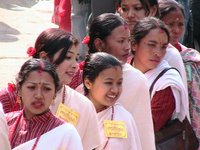
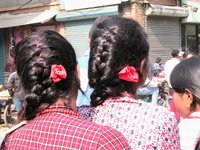
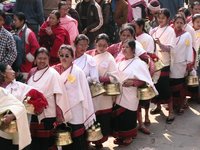
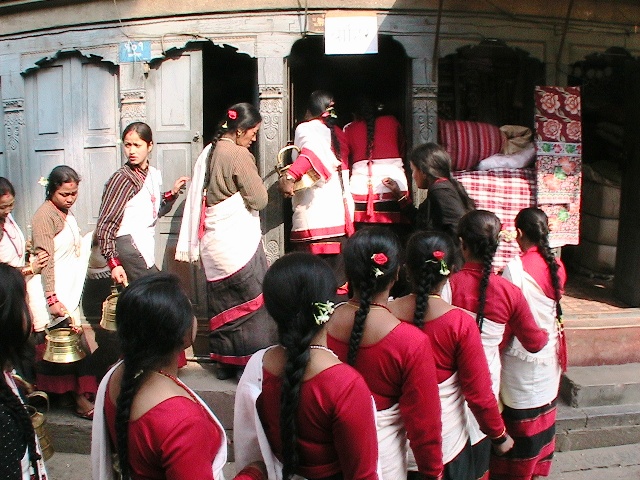
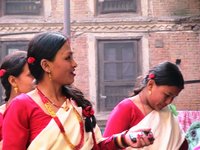 I am the greatest fan of Haku Patasi in the whole of Kathmandu. I went berserk when I saw hundreds and hundreds of cute young things (and cute old things, too) parade through Janabahaa in brilliant red, black and white on Bala Charey last year. Some were showing off their slick cell phones, while others willingly posed for the camera, flashing their red roses of love on neatly pleated fishtail hairdo. Bala Charey this year falls on November 19 – come and enjoy the sights and sounds at Janabahaa, and share a little bit of the madness with me. Photos by Alok Tuladhar.
Wednesday, November 08, 2006
What's going on?
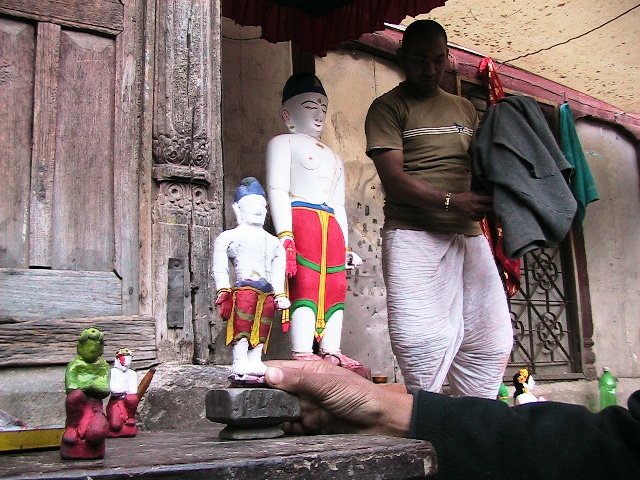
Hey, what’s the deal here? Anyone wish to explain this one? Just click on the “comments” button below and type away. No need to register.
Tuesday, November 07, 2006
Arial view of Janabahaa
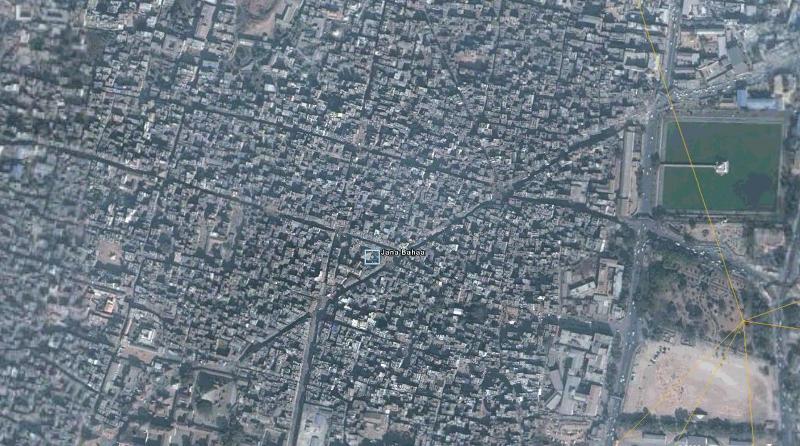
This is a satellite picture of central Kathmandu taken from 30,000 miles up in space, using a humongous telephoto lens. Janabahaa is marked with a little blue square near the center. This photo, unfortunately, was not taken by Alok Tuladhar. J
The office design

The Janabahaa Heritage Information Center office was designed by professional architect Umesh Tamrakar. Not only did he do that completely voluntarily, it was done overnight. Most of the plans envisioned in the drawing has been carried out.
The logo, finally

The fourth (and hopefully the final) version of the logo, depicting a lotus flower flanked by five leaves in a pool of blue water. Anyone care to elaborate on the meaning of these icons? Just hit the "comments" button below.
Monday, November 06, 2006
Janabahaa courtyard drawing
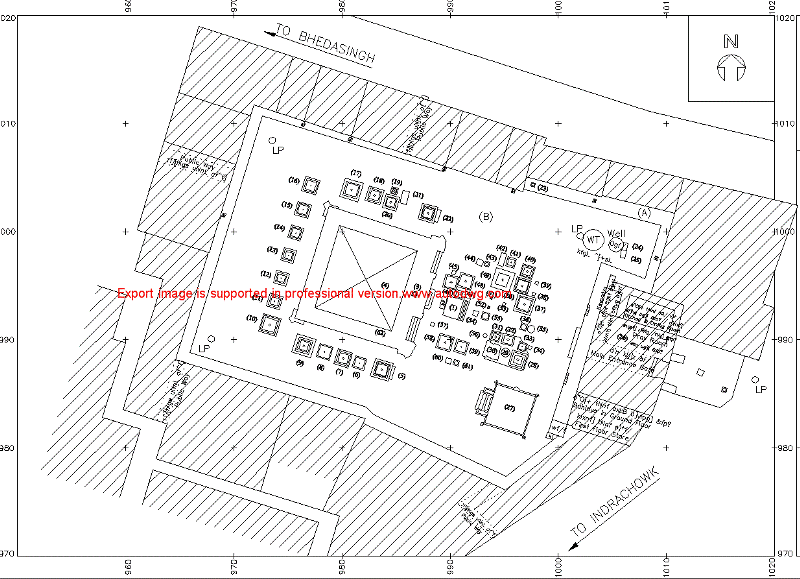
This 1:200 drawing of the Janabahaa courtyard with measurements of the main shrine, chaityas and other objects of religious and archeological importance was developed by Graphic Survey & Design Consult in December 2005.
Meeting on October 7
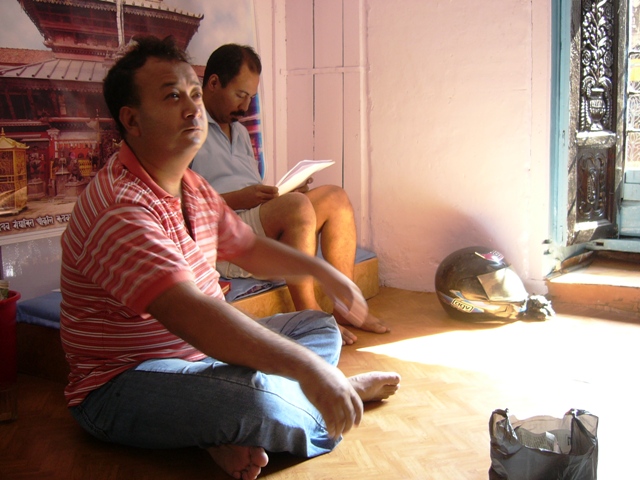
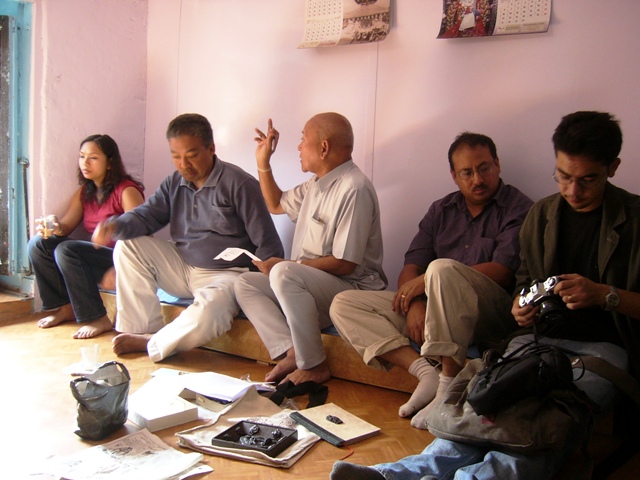
Jai Rajbhandari and Prabodh Kansakar in a reflective mood during one of the early meetings at the Janabahaa Heritage Information Center. Anil Chitrakar is all ears to what Tirtha Dhar Tuladhar has to say, while Rashmi Kansakar (far left), Tulsi Tuladhar and a young photographer volunteer (far right) look on. Photos by Alok Tuladhar.
Highlighting ancient inscriptions
 Rashmi Kansakar powders washed-out writings on various artifacts in and around Janabahaa to make them more visible so that experts can decipher the text more easily. Photo by Alok Tuladhar.
Sakimila Punih at Janabahaa
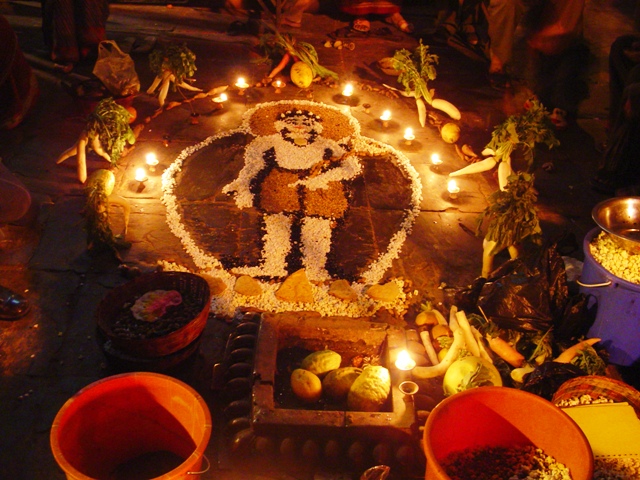
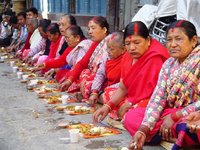
Sakimila Punih was celebrated with a flurry of activities at Janabahaa today. Some members of the Jyapu community enjoyed a hearty feast during the daytime after completion of religious ceremonies. In the evening the Halmandi festivities were observed with gusto by local gurujus. Photos by Alok Tuladhar.
Saturday, November 04, 2006
Janabahaa Society calendars released

Alok Tuladhar and family sell the new year calendar published by the Society at the cultural parade ceremony organized at Basantapur on the occasion of Nepal Sambat new year 1127 (Mha Puja). The calendar, with Gregorian, Bikram Sambat and Nepal Sambat dates, is available for sale at a nominal cost of Rs. 10 per copy at the Janabahaa Heritage Information Center at Janabahaa or at Nati Bajra's book shop (Safu Dhukuu) at Bhotahity. You can also send email to info@janabahaa.org.np to place your order.
Friday, November 03, 2006
Janabahaa Society calendars for sale
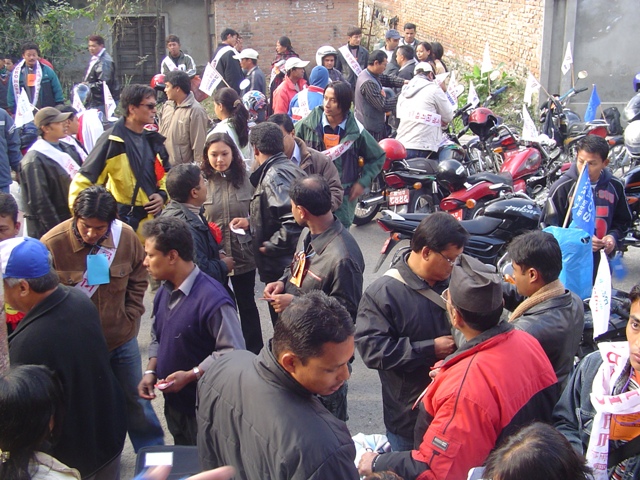
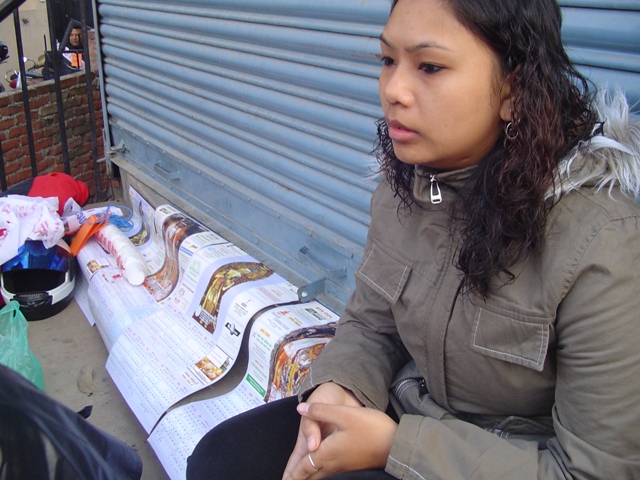
Rashmi Kansakar, the office manager at the Janabahaa Heritage Information Center, sells the new year calendar published by the Society at the kick off ceremony of the Kathmandu-Dolakha-Kathmandu motorcycle rally organized on the occasion of Nepal Sambat 1127. The calendar, with Gregorian, Bikram Sambat and Nepal Sambat dates, is available for sale at a nominal cost of Rs. 10 per copy at the Janabahaa Heritage Information Center at Janabahaa or at Nati Bajra's book shop (Safu Dhukuu) at Bhotahity. You can also send email to info@janabahaa.org.np to place your order. Photos by Alok Tuladhar.
Subscribe to:
Posts (Atom)


 Posts
Posts

