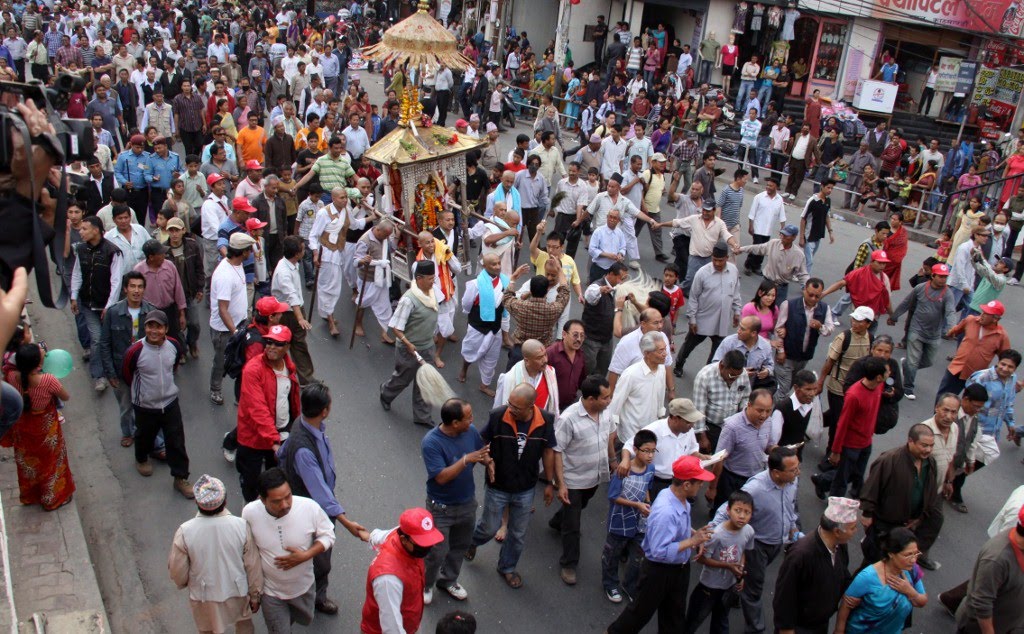
The annual festival of pulling Janabahaa Dyo’s chariot through the old part of Kathmandu kicked off from the southern end of Durbar Marg, just outside Teendhara Pathsala, on March 23, 2010, Tuesday, at about 5 pm.
Every year, this auspicious event coincides with Chaite Dashain, though it has nothing to do with that Hindu festival. Thousands of revelers joined in in this amazing event, and accompanied the chariot towards Ratnapark, Bhotahity and Ason.
Earlier, the statue of Janabahaa Dyo was put in an artistic palanquin at Janabahaa and carried to Durbar Marg by ten caretaker priests, who had undergone ritual purification procedures.
The palanquin procession was participated in by thousands of devotees, accompanied by several cultural and traditional musical groups who had converged at Janabahaa from different parts of Kathmandu to take part in this event.
Photos by Alok Tuladhar.
Coming Soon to a Browser Near You:
Live Street Video : : 10 cameras : : 24 hours
Wednesday, March 31, 2010
Tuesday, March 23, 2010
Janabahaa Photo Story in Republica Daily
A major win for the publicity of Janabahaa was achieved on February 5, 2010. On that day, the weekly edition of national broadsheet daily Republica published the blog entry entitled “A Day in the Life of a Caretaker Priest” in its center-spread photo feature. It so happened that the editor of the weekly edition (“The Week”) of the paper had seen the blog entry, and decided it was worthy of reproducing in the photo feature of The Week.
The online version of Republica, especially the weekly edition, has a huge and ever-growing readership among Nepali communities living abroad and among foreigners who are interested in Nepal.
The remuneration provided by Republica for contributing this feature has been deposited in Janabahaa’s clean-up funds by photographer/blogger Alok Tuladhar.
The online version of Republica, especially the weekly edition, has a huge and ever-growing readership among Nepali communities living abroad and among foreigners who are interested in Nepal.
The remuneration provided by Republica for contributing this feature has been deposited in Janabahaa’s clean-up funds by photographer/blogger Alok Tuladhar.
Tuesday, March 16, 2010
A Victory for Bijay
Bijay is only in his early-40s, but has the experience and confidence like that of a veteran. A highly successful businessman in a very unique product line, he has been the inspiration to many copycat entrepreneurs. The leadership qualities that he has honed to sharpness in business have visibly overflown to community work at Janabahaa.
Bijay takes bold initiatives, coming up with new ideas. And then he shows others the way by getting his hands dirty, literally speaking. Results are inevitable – and it is only a matter of time before others pitch in to support Bijay’s ventures.
Together with the preservation and promotion of Janabahaa, Bijay is especially concerned about its physical cleanliness. He has led a team of fellow compatriots from Janabahaa to publish a wall calendar on the occasion of Nepal Era 1130 New Year celebrations last fall. The funds saved from that project are being used primarily to hire a full-time staff member who oversees the cleanliness and general orderliness of Janabahaa.
In the last two months since the “cleanliness supervisor” has been deputed to Janabahaa, its overall neatness has improved drastically. Thanks to his able leadership and foresight, Bijay has now achieved victory in his war against filth in Janabahaa.
Bijay has an avid interest in history, and is a collector of historical coins. He grew up in the Janabahaa courtyard, but currently lives in the south-western part of town. Bijay is the owner and chief executive of Ratnapark Paun Bhandar, a confectionery that produces sweet, hot and sour candy from the “lapsi” or “aamali” fruit that is indigenous to the hills surrounding Kathmandu valley. The candy is hugely popular, especially among the younger generation, for its mouthwatering, savory, exotic taste.
Photos by Alok Tuladhar.
Bijay takes bold initiatives, coming up with new ideas. And then he shows others the way by getting his hands dirty, literally speaking. Results are inevitable – and it is only a matter of time before others pitch in to support Bijay’s ventures.
Together with the preservation and promotion of Janabahaa, Bijay is especially concerned about its physical cleanliness. He has led a team of fellow compatriots from Janabahaa to publish a wall calendar on the occasion of Nepal Era 1130 New Year celebrations last fall. The funds saved from that project are being used primarily to hire a full-time staff member who oversees the cleanliness and general orderliness of Janabahaa.
In the last two months since the “cleanliness supervisor” has been deputed to Janabahaa, its overall neatness has improved drastically. Thanks to his able leadership and foresight, Bijay has now achieved victory in his war against filth in Janabahaa.
Bijay has an avid interest in history, and is a collector of historical coins. He grew up in the Janabahaa courtyard, but currently lives in the south-western part of town. Bijay is the owner and chief executive of Ratnapark Paun Bhandar, a confectionery that produces sweet, hot and sour candy from the “lapsi” or “aamali” fruit that is indigenous to the hills surrounding Kathmandu valley. The candy is hugely popular, especially among the younger generation, for its mouthwatering, savory, exotic taste.
Photos by Alok Tuladhar.
Tuesday, January 19, 2010
A Day in the Life of a Caretaker Priest
Prakash Shakya feels privileged to take his turn as the caretaker priest this month at the Buddhist temple of Karunamaya (Janabahaa Dyo or Aryavalokiteshwor), also worshipped as White Machhindranath by Hindus. As part of his duty, he has to perform several rituals daily and follow strict rules to stay pure.

The cult of Karunamaya is an ancient one. Karunamaya is revered by Buddhists across the world as "the compassionate one."
The Janabahaa courtyard, located in the heart of the city, is among the most important Buddhist sites in Kathmandu, and dates back to 4th Century BC. The central Karunamaya temple was added in 16th century AD. The complex today continues to be the hotspot of traditional Newaa culture, architecture and music, as well as the central location where religious activites of the Vajrayana sect of Buddhism are practiced.
Before entering the temple in the morning, which takes place at around 5 am, he needs to take a bath, in the open.
He has to cook his own food. The diet is strictly vegetarian, but onion and garlic is not allowed. Only one meal a day is allowed -- lunch. Milk and fruits can be taken in the evening if desired.Some of the rice he cooks is first offered to the deity, and then to the birds, before he can eat.
Newspapers are the only resource for him to keep in touch with the outside world.
Devotees and family are allowed to enter the outer chamber of the temple, but only the caretaker priest can enter the inner sanctuary.
Mother and sister ensure all impure objects, such as shoes, are out of the way before the encircling ritual, and make sure that nobody touches him. If he does touch anyone accidentally, he needs to purify himself before he can enter the temple again.
The encircling ritual is followed by reciting of special prayers while fanning the deity with a yak's tale attached to a silver handle. This special implement is called "chwamo" in the Newaa language.Devotees of Karunamaya commonly offer butter lamps to the deity.
Another member of the priest clan recites the "Namsangati" prayer every evening.
Photos by Alok Tuladhar.
Monday, January 11, 2010
Faces VI (Among the Five Thousand)
A brief, informal survey was conducted a few days ago to try and estimate the number of people who visit Janabahaa every day. Exactly 137 people entered Janabahaa between 4:45 pm and 5:15 pm from the main gate, and 24 people entered from the back gate in the western side. Assuming this traffic to be the average flow of people passing through Janabahaa from 5 am to 9 pm, we arrive at over five thousand people per day! That too on a day when no festivals or special ceremonies occur. That is a lot of visitors for a single location.
Photos by Alok Tuladhar.
Wednesday, January 06, 2010
Karmabhumi
She is being trained for her future occupation.
And so is he.
Enough training for today... time for a milk break, straight from mom.
Photos by Alok Tuladhar.
Wednesday, December 30, 2009
Before the Big Bath... and After
Here are some glimpses of the environment in Janabahaa in the evening of Janabahaa Dyo's annual bathing ritual.
The stage is set (meaning, it is cleaned thoroughly to try and rid it of the pigeon droppings as much as possible).
The people start gathering from late afternoon onwards.
Representation of the older devotees is understandably large.
A large religious crowd means a large marketplace for religious books and pictures.
It is either the old or the very young who show up. The youth, sadly, do not seem too interested.
The seven-headed serpent or "Nagaraja" protects Janabahaa Dyo.
All the "seats" are soon gone.
Only standing space is available now.
The biting mid-winter chill does not seem to deter the devotees.
The headgear worn by the officiating priest during the bathing ceremony.
The crown represents Janabahaa Dyo while the idol is removed from its sanctuary.
Devotees vie for drops of the holy liquid (water from Bishnumati River, milk, ghee and honey) from which the idol of Janabahaa Dyo was given a bath.
A popular and highly knowledgeable priest of Vajrayana Buddhism talks to Avenues Television after the ceremony.
Photos by Alok Tuladhar.
Subscribe to:
Posts (Atom)