Coming Soon to a Browser Near You:
Live Street Video : : 10 cameras : : 24 hours


Tuesday, August 24, 2010

Exterior Up-close (East Face)


Though the overall temple as an edifice is quite impressive even to the most seasoned onlooker, much of the detailed ornamentation on the exterior of the temple, especially on the upper floor, is not visible to the casual visitor, largely due to the muck and grime that has accumulated over decades. Getting closer, however, reveals an amazing array of intricate creations, made of both wood and metal.

The hard-to-see window in the center between the two roofs is metallic, and probably gold-plated.

Many of the objects d'art are accompanied by text in Ranjana or Prachalit script, and remain a reliable and authentic source of our glorious history.

Awe-inspiring images of various Lokeshwors are carved on all of the inclined wooden struts that support the lower and upper roofs.

Colorful, decorative carvings at the bottom of a wooden strut.

Elaborate design on a window that provides ventilation to the upper floor.

Photos by Alok Tuladhar.

Sunday, August 22, 2010

No Kidding


A bunch of kids. A lazy Saturday afternoon. Janabahaa. Perfect ingredients to make Janabahaa abuzz with an hour of hectic activity, fun and educational not only for the energetic kids but also for the lethargic locals.


First, divide the kids into two groups – one group with the younger kids and the other with the older ones. Ask the smaller kids to draw something on the tiled flooring with some sidewalk chalk, and they will not only come up with a big, bright rainbow in no time, but will also manage to pen down a message for the residents and store owners of Janabahaa: “Say No to Poly(thene) Bags.”


Ask the older kids to draw something, and immediately they will come up with an imaginary creature.


And then ask the older kids to find answers to three questions with the help of local people: what are the three names of Janabahaa, what are the three names of the deity who resides in the main temple in Janabahaa, and in which king’s reign was the main temple in Janabahaa built. They will immediately run around the complex, talking to every adult they bump into, and easily find answers to the first two questions.


But even after a good twenty minutes, they cannot come up with the answer to the third question, because none of the locals knew the answer.

Do you?

Photos by Alok Tuladhar.

Divine Light Rids Janabahaa of Darkness

A pair of panels of photo voltaic cells is the latest addition in Janabahaa. The solar panels charge a truck battery which powers an inverter which in turn powers half a dozen compact fluorescent lamps (CFLs) installed inside the Janabahaa complex. Thanks to the addition of a little bit of technology, residents of Janabahaa, and Karunamya Aryavalokiteshwor himself, are shielded from the notorious power cuts that the rest of the country suffers from during the dry months.

Photo by Alok Tuladhar.

Monday, August 16, 2010

Charya Dance Enthralls Janabahaa Audience

Organized by Macchindra Club, a Charya dance program was performed by the Lalitpur-based Singhini Research Center in the evening of July 23, 2010 on the street just outside the main gate of Janabahaa for the benefit of the general public.

Charya Nritya is an ancient ritual dance that dates back to over a thousand years, and is a religious discipline of the Vajrayana priests of Kathmandu, who perform the dance as part of their esoteric meditation practices, ceremonies and rituals.

The Newa Buddhist priests dance the Charya Nritya in a state of deep meditative awareness in order to embody the living presence of the compassionate, peaceful, and fierce divinities of the Vajrayana Buddhist pantheon.

Charya dance, which means “dance as a spiritual discipline,” is a sacred dance form.

Charya dance is a meditation discipline, vehicle of bodily and spiritual transformation, and opportunity for an audience to experience a vision of divine beauty.

After the performance at Janabahaa, the dance troupe has embarked on a trip to Switzerland and USA where they will be presenting special performances of the Charya dance. An excellent reference site to learn more about the Charya dance is http://www.dancemandal.com.

Photos by Alok Tuladhar.

Saturday, August 14, 2010

Reclaiming the Streets


Starting July 31, 2010 – the red banner declared – all illicit “footpath” stalls will be banned, as they encroached upon public land, causing hindrance to pedestrian and vehicular traffic and defacing the city. With joint efforts of Kathmandu Municipality, police, traffic police, local ward office, Asan Sewa Samiti, Machhindra Club, Balkumari Khel Mandal and Indrachok Club, the ban has been enforced effectively and peacefully since that date.

This ban was enforced along the stretch between Asan and Wonghah (Indrachowk), including in the large open area just outside the Janabahaa main gate. This new development is seen by many as an excellent example of non-government and government cooperation for effective, immediate results.

Half a dozen hired “security guards” are now on duty throughout the day to enforce the ban on infringing street hawkers. Police and municipality officers also patrol the area more frequently now to help keep the streets free from unruly street vendors. These enforcement personnel not only ensure that touts relinquish the streets that they had occupied illegitimately, but also persuade storekeepers not to use public space to display their products.

 Photos by Alok Tuladhar.

Policing…. nahhhh. Patrolling… yeah!


Scouts are always prepared. Members of the Machhindra Rover Ranger Crew, affiliated to Macchindra Club, are helping keep the Janabahaa premises clean with much vigor and enthusiasm.

Not only do the boy scouts help collect the garbage, they also talk to residents and shopkeepers about the importance of keeping the complex spotless.

As the younger generation get more involved in Janabahaa, they develop a keen interest in its priceless heritage, grooming themselves to take up conservation work with renewed energy.

Cleaning never stops at Janabahaa. Earlier blog entries about the continuous cleaning efforts are given below:

Photos by Alok Tuladhar.

Thursday, August 12, 2010

Glitter under the Grime: Citrus Juice to the Rescue


The decorative brass-work hanging from the lower roof, before it was cleaned. The dirt was accumulated over decades, primarily from pigeon droppings and exposure to the elements.

The metal surface is coated with citrus juice and left alone for a few days until the natural acid eats away all the filth, without causing any damage to the metal.

The brilliant, shining gold-plated surface is suddenly exposed for all humanity to appreciate after a simple hosing down with water.

The left section is yet to be cleaned, whereas the right section glitters after a few days’ work by one person.

Bamboo scaffolding put up for the cleaning work.

If you wish to get periodic updates via email about the happenings at Janabahaa and its periphery, please write to alok@nepmed.com. All photos by Alok Tuladhar.

Wednesday, March 31, 2010

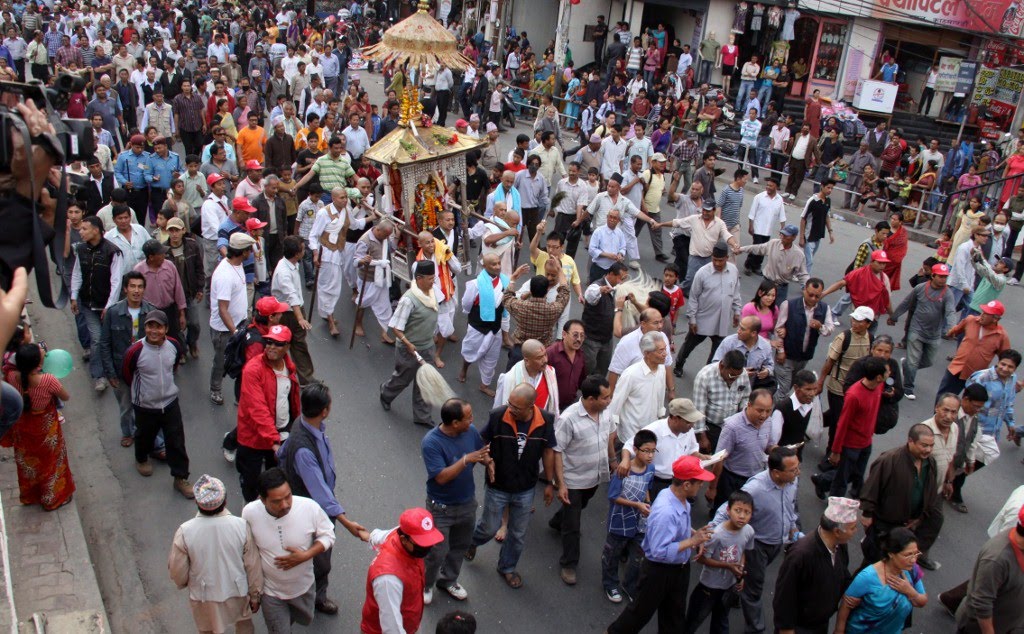
Chariot Festival Day 1 (Preparation & Palanquin Trip)

The annual festival of pulling Janabahaa Dyo’s chariot through the old part of Kathmandu kicked off from the southern end of Durbar Marg, just outside Teendhara Pathsala, on March 23, 2010, Tuesday, at about 5 pm.

Every year, this auspicious event coincides with Chaite Dashain, though it has nothing to do with that Hindu festival. Thousands of revelers joined in in this amazing event, and accompanied the chariot towards Ratnapark, Bhotahity and Ason.

Earlier, the statue of Janabahaa Dyo was put in an artistic palanquin at Janabahaa and carried to Durbar Marg by ten caretaker priests, who had undergone ritual purification procedures.

The palanquin procession was participated in by thousands of devotees, accompanied by several cultural and traditional musical groups who had converged at Janabahaa from different parts of Kathmandu to take part in this event.

Photos by Alok Tuladhar.

Tuesday, March 23, 2010

Janabahaa Photo Story in Republica Daily

A major win for the publicity of Janabahaa was achieved on February 5, 2010. On that day, the weekly edition of national broadsheet daily Republica published the blog entry entitled “A Day in the Life of a Caretaker Priest” in its center-spread photo feature. It so happened that the editor of the weekly edition (“The Week”) of the paper had seen the blog entry, and decided it was worthy of reproducing in the photo feature of The Week.


The online version of Republica, especially the weekly edition, has a huge and ever-growing readership among Nepali communities living abroad and among foreigners who are interested in Nepal.

The remuneration provided by Republica for contributing this feature has been deposited in Janabahaa’s clean-up funds by photographer/blogger Alok Tuladhar.

Tuesday, March 16, 2010

A Victory for Bijay

Bijay is only in his early-40s, but has the experience and confidence like that of a veteran. A highly successful businessman in a very unique product line, he has been the inspiration to many copycat entrepreneurs. The leadership qualities that he has honed to sharpness in business have visibly overflown to community work at Janabahaa.

Bijay takes bold initiatives, coming up with new ideas. And then he shows others the way by getting his hands dirty, literally speaking. Results are inevitable – and it is only a matter of time before others pitch in to support Bijay’s ventures.

Together with the preservation and promotion of Janabahaa, Bijay is especially concerned about its physical cleanliness. He has led a team of fellow compatriots from Janabahaa to publish a wall calendar on the occasion of Nepal Era 1130 New Year celebrations last fall. The funds saved from that project are being used primarily to hire a full-time staff member who oversees the cleanliness and general orderliness of Janabahaa.

In the last two months since the “cleanliness supervisor” has been deputed to Janabahaa, its overall neatness has improved drastically. Thanks to his able leadership and foresight, Bijay has now achieved victory in his war against filth in Janabahaa.

Bijay has an avid interest in history, and is a collector of historical coins. He grew up in the Janabahaa courtyard, but currently lives in the south-western part of town. Bijay is the owner and chief executive of Ratnapark Paun Bhandar, a confectionery that produces sweet, hot and sour candy from the “lapsi” or “aamali” fruit that is indigenous to the hills surrounding Kathmandu valley. The candy is hugely popular, especially among the younger generation, for its mouthwatering, savory, exotic taste.

Photos by Alok Tuladhar.